
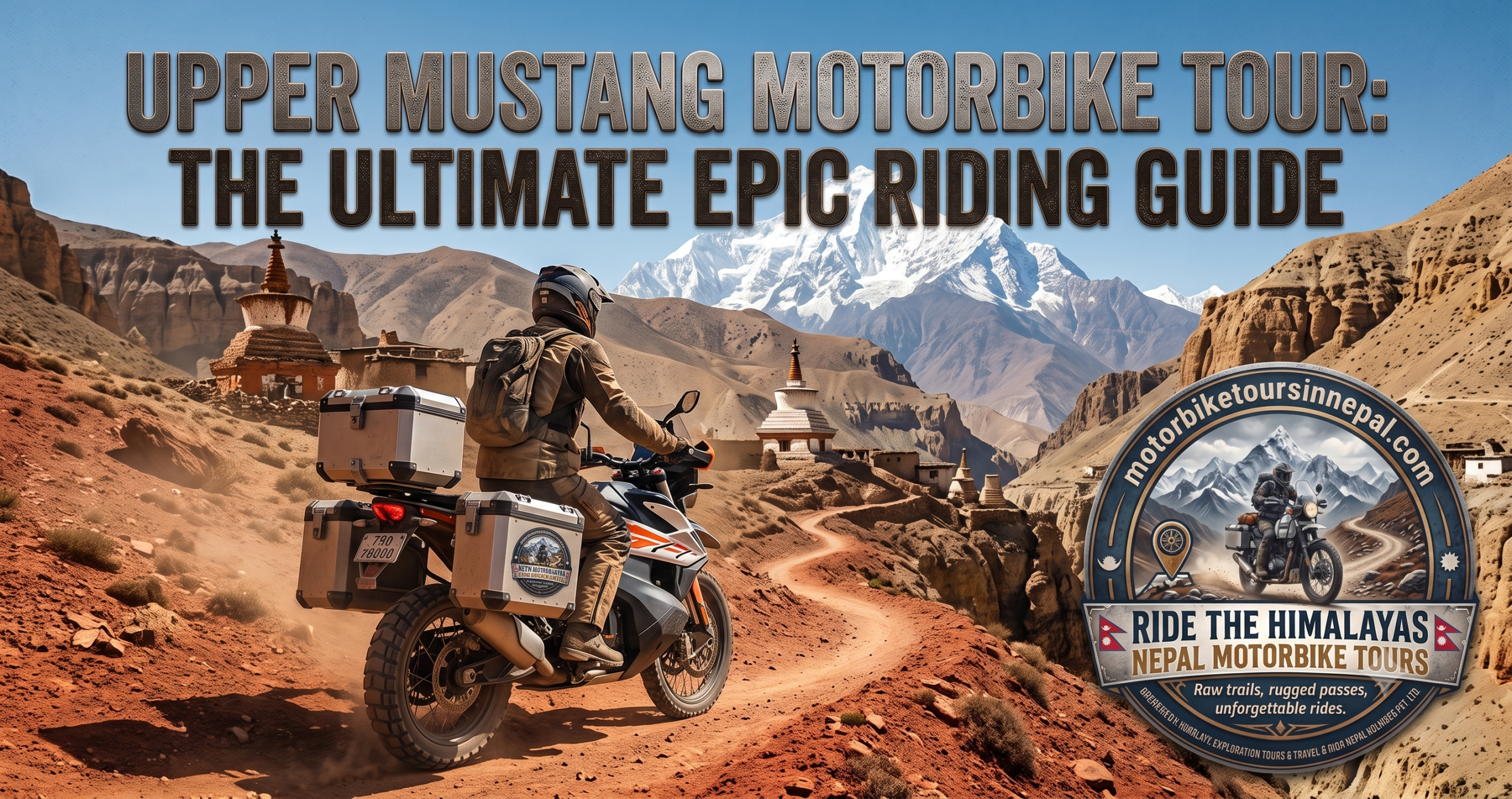
An Upper Mustang Motorbike Tour is widely considered the ultimate holy grail for high-altitude adventure motorcycling in Asia. Tucked away behind the formidable rain shadow of the Annapurna and Dhaulagiri mountain ranges, the ancient Kingdom of Lo offers a landscape unlike anywhere else on Earth. Riding through this remote valley takes you from lush, subtropical pine forests to a barren, wind-carved Himalayan desert steeped in Tibetan Buddhist traditions.
If you are craving a life-changing Nepal adventure tour that combines technical dirt riding, soaring mountain passes, medieval walled cities, and ancient cliff caves, this expedition delivers on every front.
[IMAGE SUGGESTION: A dual-sport motorcycle parked on a dirt track overlooking the arid, canyon landscapes of Upper Mustang | Recommended Alt Text: “Upper Mustang Motorbike Tour rider taking in the scenic Himalayan canyon view”]
Trip Highlights at a Glance
| Feature | Details |
| Total Distance Covered | ~930 km |
| Maximum Elevation | 4,660 meters (Kora La Pass / Tibet Border) |
| Terrain Profile | 40% Paved Highway, 60% Technical Off-Road (Gravel, Dirt, Sand, Rocks) |
| Riding Difficulty | Intermediate to Advanced |
| Key Attractions | Walled City of Lo Manthang, Muktinath, Kali Gandaki Gorge, Chhoser Sky Caves, Tatopani Hot Springs |
Detailed 8-Day Upper Mustang Motorbike Itinerary
Day 1: Kathmandu to Bandipur – Leaving the Valley Floor
- Distance: ~150 km
- Riding Time: 5 to 6 hours
- Maximum Altitude: 1,030 meters
- Terrain: Fully paved highway with heavy urban traffic exiting Kathmandu, leading into winding mountain asphalt.
Your journey begins in the vibrant chaos of Kathmandu. Pushing through the dense morning traffic along the Prithvi Highway, you quickly gain altitude before descending into the Trishuli River basin. The air warms as you trace the turquoise river, navigating long, sweeping mountain bends that give you a feel for your machine.
After roughly four hours of asphalt cruising, turn off the main highway at Dumre and begin a steep, scenic climb up a ridge toward the hill town of Bandipur. The sealed switchbacks offer stunning views of the Marsyangdi River valley below.
Bandipur is a preserved Newari cultural haven where motor vehicles are prohibited in the town center. After parking your bike, stroll down the polished cobble streets framed by traditional 18th-century timber architecture. Watch the sunset over the Annapurna range while enjoying fresh local cuisine at a balcony café.
Rider Tip: Traffic leaving Kathmandu through the Nagdhunga Pass can be intense and dusty. Keep your visor down, maintain a conservative distance behind freight trucks, and reserve your energy for the afternoon twisties up to Bandipur.
Day 2: Bandipur to Tatopani – Entering the Off-Road Realm
- Distance: ~145 km
- Riding Time: 6 to 7 hours
- Maximum Altitude: 1,190 meters
- Terrain: Smooth asphalt to Pokhara and Beni, transitioning to rough dirt, riverbed gravel, and mud tracks.
Descend the winding roads from Bandipur back to the highway and twist the throttle toward Pokhara. This stretch provides smooth blacktop and picturesque valley views. After bypassing Pokhara city, continue west through the foothill settlements toward Beni.
Beni marks the official boundary between asphalt comfort and raw dirt terrain. Here, smooth blacktop disappears, giving way to the unpaved corridor of a thrilling Nepal offroad tour. Following the roaring Kali Gandaki River upstream, the path transforms into loose gravel, rocky trails, and occasional water crossings fed by alpine waterfalls.
As dusk falls, roll into the sub-tropical sanctuary of Tatopani. Famous for its natural riverside thermal springs, Tatopani is the perfect spot to soothe your aching muscles. Submerging in the hot, mineral-rich water while listening to the roaring river nearby is the ultimate reward after your first real taste of dirt riding.
Day 3: Tatopani to Jomsom – Riding the Deepest Gorge in the World
- Distance: ~55 km
- Riding Time: 4 to 5 hours
- Maximum Altitude: 2,720 meters
- Terrain: Technical off-road, loose shale, riverbed stones, steep climbs, and narrow cliffside paths.
Though short on paper, today’s route requires intense focus. You will be carving through the Kali Gandaki Gorge, structurally recognized as the deepest canyon on Earth—sandwiched between the 8,000-meter giants of Annapurna I and Dhaulagiri.
Shortly after leaving Tatopani, you will encounter the dramatic Rupse Waterfall. Take a short breather here to capture photos before tackling the narrow, cliff-hanging dirt tracks ahead. You will navigate loose riverbed rocks, standing water crossings, and sudden mud sections where standing on your footpegs is essential for stability.
[Technical Riding Checkpoint]
- Keep a light grip on the handlebars over loose gravel.
- Weight the outside footpeg when carving mountain switchbacks.
- Keep your eyes looking where you WANT to go, not at the cliff edge!
Pass through the picturesque village of Marpha, famous for its whitewashed stone houses and lush apple orchards. By early afternoon, you will cross the valley basin into Jomsom. Known for its fierce afternoon gale-force winds, Jomsom acts as the commercial gateway to Lower Mustang. Use the afternoon to rest, acclimate to the higher altitude, and take a short side-ride up to the serene, emerald waters of Dhumba Lake.
For details on local conservation efforts and trail rules in this sensitive ecological area, consult the https://ntnc.org.np/project/annapurna-conservation-area-project-acap.
Day 4: Jomsom to Lo Manthang – Crossing into the Walled Kingdom
- Distance: ~95 km
- Riding Time: 7 to 8 hours
- Maximum Altitude: 3,840 meters (Crossing Nyi La Pass at 4,010 meters)
- Terrain: High-altitude desert dirt tracks, deep dust beds, loose shale climbs, and high mountain passes.
Today is the crown jewel of your motorbike tour to upper mustang. Ride 15 kilometers north from Jomsom to Kagbeni, the historic border village where police check your Restricted Area Permit. Passing through Kagbeni feels like crossing a portal back in time.
The lush greenery disappears entirely, replaced by vibrant red rock cliffs, carved canyons, and ancient sky caves suspended on vertical faces. The trail climbs steadily toward high-altitude passes, including the formidable Nyi La Pass ($4,010\text{ m}$). You will encounter deep dust beds (often called “fesh-fesh”), loose shale, and strong headwinds that test your throttle control.
[IMAGE SUGGESTION: View of the ancient walled city of Lo Manthang in a desert Himalayan basin | Recommended Alt Text: “The walled city of Lo Manthang seen during an Upper Mustang Motorbike Tour”]
Descending from the final ridge, the iconic walled capital of Lo Manthang emerges from the vast desert floor. Passing through the outer city gates, you enter a ancient Tibetan settlement that remained largely off-limits to westerners until 1992.
Day 5: Lo Manthang Exploration – Monasteries, Sky Caves, and the Tibetan Border
- Distance: ~30–40 km (Local Exploration)
- Riding Time: 2 to 3 hours
- Maximum Altitude: 4,660 meters (Kora La Pass)
- Terrain: Open high-altitude plateaus, dirt tracks, and wide gravel basins.
Spend your morning exploring the narrow stone alleyways of Lo Manthang on foot. Visit the 15th-century monasteries of Thubchen Gompa and Jampa Gompa, where intricate murals and colossal bronze statues offer an intimate look at ancient Himalayan culture. You may also catch a glimpse of the historical King’s Palace in the city center.
In the afternoon, gear up for an unforgettable high-altitude ride up to the Chhoser cave complex. Here, you can hike into the Shija Jhong cave, a 5-story cliff complex containing dozens of individual rooms carved out centuries ago for habitation and defense.
If weather and road conditions permit, extend your ride north across wide mountain plateaus to Kora La Pass ($4,660\text{ m}$)—the official border post separating Nepal and Tibet. Standing at this high pass offers expansive, panoramic views across the Tibetan Plateau.
Cultural Respect Tip: Always walk or ride clockwise around Buddhist stupas, mani walls, and chortens. It is a sign of respect in local Mustang tradition.
If you are evaluating equipment choices for high-altitude riding conditions like these, check out our complete breakdown on [Internal Link: “how to prepare your bike for high altitude riding” -> /bike-preparation-guide/].
Day 6: Lo Manthang to Marpha – Descending the Canyon
- Distance: ~100 km
- Riding Time: 6 to 7 hours
- Maximum Altitude: 3,840 meters down to 2,670 meters
- Terrain: Technical downhill off-road, deep dust, loose gravel, and strong afternoon riverbed headwinds.
Say goodbye to the enchanted walled city and begin your descent south back toward lower elevations. Retracing your steps reveals a totally different visual perspective of the dramatic rock formations, ancient ruins, and multi-colored earth layers.
Downhill off-road riding requires active standing posture, careful engine braking, and smooth front-brake modulation to avoid losing traction on loose, powdery dirt. As you drop down into the Kali Gandaki riverbed past Kagbeni, expect strong afternoon winds that blow steadily up the canyon corridor. Maintain a low body profile on the bike and hold a solid grip on the bars.
Push past Jomsom and end your day in Marpha. Stroll down its clean flagstone streets, enjoy a cold apple cider, and taste authentic local apple pie freshly baked by village lodges.
Day 7: Marpha to Pokhara – Return to Lush Valleys
- Distance: ~160 km
- Riding Time: 7 to 8 hours
- Maximum Altitude: 2,670 meters down to 822 meters
- Terrain: Rough, rocky dirt tracks from Marpha to Beni, returning to smooth paved asphalt from Beni to Pokhara.
Tackle the final unpaved stretch of your off-road itinerary as you carve down from Marpha back through Tatopani to Beni. The jarring, rocky trails will test your endurance one last time, but as you pull into Beni, the blacktop returns.
The contrast is instant. Swooping along smooth asphalt back toward Pokhara feels effortless after days spent in the Himalayan dust. Arrive in Pokhara by late afternoon, check into your hotel, and trade your dusty motorcycling boots for sandals.
Celebrate the completion of your off-road expedition by relaxing alongside the peaceful shores of Phewa Lake. Enjoy cold beverages, live acoustic music, and a warm meal at one of Lakeside’s many vibrant restaurants.
For official updates on highway infrastructure, regional weather alerts, and travel advisories across Nepal, visit the https://ntb.gov.np/.
Day 8: Pokhara to Kathmandu – The Victory Lap
- Distance: ~200 km
- Riding Time: 6 to 7 hours
- Maximum Altitude: 1,400 meters
- Terrain: Fully paved highway, winding mountain twists, heavy regional traffic.
The final leg of your journey follows the Prithvi Highway back east toward the capital. Enjoy the sweeping curves along the Trishuli River basin, stopping for tea at highway eateries along the way.
As you conquer the final mountain climbs back into the Kathmandu Valley, you will officially complete an epic 900+ kilometer trans-Himalayan motorcycle tour. Reflect on the mountain passes, ancient sky caves, and rugged dirt trails you conquered over the past eight days.
[IMAGE SUGGESTION: Group of adventure motorcycling tourists celebrating at an altitude pass banner in Upper Mustang | Recommended Alt Text: “Riders celebrating on an Upper Mustang Motorbike Tour”]
Practical Travel Tips & Insider Advice
Organizing a remote motorcycle expedition into the Himalayas requires careful preparation. Here is what you need to know before you head out:
1. Restricted Area Permits (RAP) & Entry Logistics
Upper Mustang is a regulated border zone. To ride north of Kagbeni, foreign visitors must obtain a Restricted Area Permit (RAP), which costs approximately $50 USD per person per day for upto 10 days, alongside an Annapurna Conservation Area Permit (ACAP). Individual solo travelers cannot obtain this permit alone; you must book through an officially registered local trekking or motorcycling agency.
2. Choosing the Right Motorcycle for a Nepal Offroad Tour
Selecting the proper bike can make or break your trip. Here are the top choices for this route:
- Royal Enfield Himalayan 411 / 452: The workhorse of the Himalayas. Offers low-end torque, comfortable ergonomics, and easy repairs in remote mountain villages.
- Honda CRF 300 Rally: Lightweight, nimble, and features long-travel suspension—ideal for soft sand and rocky water crossings.
- KTM 390 Adventure: Excellent power-to-weight ratio with modern electronics, ideal for experienced riders comfortable with a taller seat height.
If you are unsure which bike best fits your riding style and physical frame, read our comprehensive [Internal Link: “guide to selecting the best motorcycle for Nepal offroad tours” -> /best-motorcycles-nepal-tours/].
+---------------------------------------------------------------+
|                      PRO INSIDER TIP                          |
| Always pack spare tubes, a portable 12V air compressor, basic |
| tire irons, and spare clutch/brake levers. Tire punctures     |
| on sharp Mustang slate rocks are extremely common!            |
+---------------------------------------------------------------+
3. Best Time of Year to Visit
- Spring (March to May): Warm temperatures, blooming wildflowers in the lower valleys, clear mountain views, and moderate trail conditions.
- Autumn (September to November): Crystal-clear skies, minimal rain, and optimal trail traction following the summer monsoon.
- Monsoon Season (June to August): While Upper Mustang falls in a rain-shadow zone, getting to Mustang requires riding through lower regions prone to mud and landslides.
Essential Packing List & Gear Recommendations
Riding across vast elevation changes—from hot subtropical river valleys at 800m to frozen mountain passes near 4,700m—requires a flexible, layered gear system:
- Riding Suit: Breathable, water-resistant adventure jacket and pants with CE Level 2 armor.
- Base & Mid Layers: Thermal merino wool base layers and a packable down jacket for cold evenings in Lo Manthang.
- Helmet & Eyewear: Dual-sport helmet paired with dirt goggles. Dust can be severe, making a standard drop-down sun visor hard to keep clean.
- Footwear: Sturdy, waterproof adventure/enduro boots with strong ankle support.
- Hydration: A 2-to-3 liter hydration backpack (e.g., CamelBak) to combat high-altitude dehydration.
Ready for the Adventure of a Lifetime?
An Upper Mustang Motorbike Tour is far more than just a motorcycle trip—it is an authentic journey through history, culture, and extreme high-altitude terrain. From the medieval streets of Lo Manthang to the technical dirt switchbacks along the Kali Gandaki, every kilometer delivers an exhilarating mix of challenge and discovery.
If you are looking for an unforgettable Nepal adventure tour that pushes your riding limits while immersing you in an ancient world, Upper Mustang is waiting for you. Gear up, service your engine, and prepare to conquer the forbidden kingdom on two wheels!